
← All stories
Birds, not drought, are why many farmers give up on sorghum
KALRO has released five bird-resistant sorghum varieties for the drylands. For hubs planning the next season, the interesting part is not the yield figure — it is that the obstacle being solved is the one farmers actually name.
Ask a coordinator in Machakos or Tharaka-Nithi why a farmer who grew sorghum two seasons ago is growing something else now, and drought is rarely the first answer. Birds are. A crop that survives a failed rainy season can still be stripped in the two or three weeks between the milk stage and harvest, and a farmer who has watched that happen once does not plant it again on a promise.
That is the obstacle the Kenya Agricultural and Livestock Research Organisation set out to remove. On 26 September 2025, KALRO unveiled five bird-resistant sorghum varieties bred for arid and semi-arid land, and put them in front of the public at the Nairobi International Trade Fair.
What was released
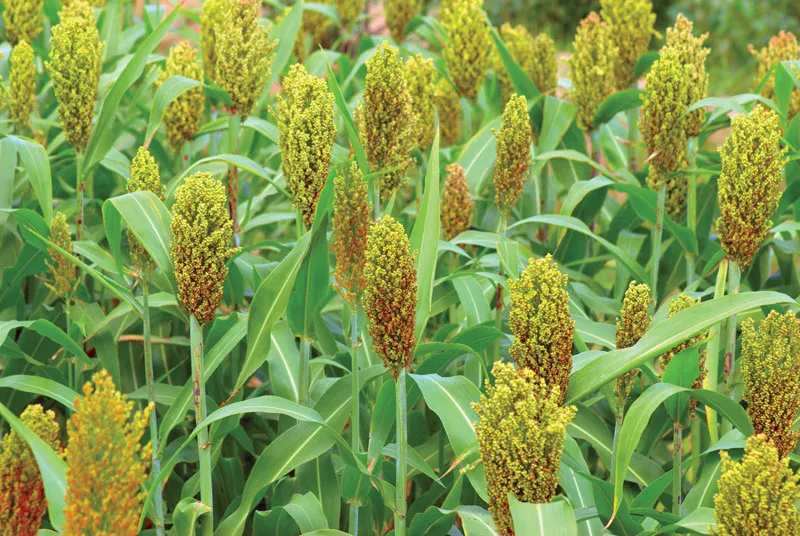
Two of the five have been named publicly so far: Pato I and Smart Sorghum. The figures reported for Smart Sorghum are the ones worth holding on to:
- Up to 15 bags an acre under dryland conditions.
- Around three months to maturity — short enough to fit a single unreliable rainy season.
- Minimal fertiliser, which matters more than yield on a farm where inputs are the binding constraint.
- Bird damage cut by up to 80 per cent — against losses that can reach 80 per cent of the crop.
Simon Kuria, who heads KALRO's Kiboko research station, put the reason for the breeding programme plainly: the recurring issue that hurt yields and kept farmers away from a climate-resistant crop was attack by birds.
Seed is already being multiplied
A released variety is not the same as available seed, and this is usually where the gap opens. In this case multiplication is under way at the Katumani research station, and Machakos County has allocated 1,000 acres per ward to bulking the seed up. That is a real supply signal, not an announcement.
The question for a hub is no longer "will there be seed?" but "how much of it should be coming to us, and have we told anyone?"
What this changes for a hub
Bird resistance changes the arithmetic of the advice a VBA gives. A farmer who refused sorghum because of quelea has a different reason to reconsider than one who refused it because of rainfall — and the two need different conversations. It is worth going back to the farmers who dropped sorghum and asking which of the two it was.
It also changes what a hub should be aggregating now. Seed companies multiply against demand they can see. A hub that records what its farmers intend to plant, variety by variety, before the planting window closes is a hub that gets seed allocated to it; a hub that waits until the window opens is competing for what is left.
Three of the five are still unnamed
We are recording this honestly: the reporting we have seen names two of the five varieties. The other three exist, but we are not going to invent names for them, and they will not appear in our catalogue until KALRO or KEPHIS confirm them. Nothing on this platform creates a variety because somebody mentioned one — a proposed variety goes to a review queue and a curator rules on it, precisely so that a hub never plans production against a name nobody can supply.
If you are a breeder, a regulator or a seed company and you know one of the remaining three, tell us through the assistant in the corner of this page. It goes straight to that review queue.
Source
Reported by Smart Farmer Kenya: KALRO unveils five bird-resistant sorghum varieties to boost farmers' yields and income. Figures and the quotation above are as reported there; we have not independently verified the trial data.
Comments
Be the first to comment.